
FALL STUDY GUIDE
Whether you’ve studied the Bible for years or are new in your faith, this 13-week study is designed to help you read, understand and apply God’s Word. Use this study guide to read the weekly passage for yourself, take sermon notes and access discussion questions to share with your Life Group.
Week 1: The Five Mantras
Weeks 2–8: Armor Up
Weeks 9–12: For the One
DISCUSSION QUESTIONS
WEEK 1: The Five Mantras
- What does it look like to embrace messy grace as a group?
- In what ways can you walk together through every season? What transitions or challenges are coming up this year?
- Full surrender is difficult, if not impossible, on your own. What benefits have you experienced by being in a Life Group?
- How can your group step out of your comfort zone and serve together? Discuss potential ideas for serving as a group.
- Northview groups are never closed. We believe in one more. Who is one person or couple you can invite to your group?
WEEK 2: This is War
- Rather than a blessing, Paul ends his letter to the Ephesians with words about a battle. Why is it important to realize that we are in a war, and our faith is contested by an enemy.
- Ephesians 6:10 tells us to "be strong in the Lord and in His mighty power”. Where are you tempted to rely on self-reliance, willpower, or trying harder in your faith?
- Ephesians 6:11 highlights schemes and strategies rather than brute force. What does this reveal about what spiritual opposition looks like in everyday life?
- Notice how Paul repeats the command to "stand" multiple times. What is the difference between standing your ground versus trying to conquer new territory in your own power?
- Paul doesn’t say, "if” the day of evil comes––he says, when it comes. How does this change the way that you read this passage?
WEEK 3: The Belt of Truth
- This past week, did you encounter any spiritual warfare? If so, what was it, and what did you do?
- Paul’s primary command in Ephesians 6 is simply to stand. In what ways is “standing” significant in literal warfare, and how does it apply to spiritual warfare?
- What does it look like to "lose ground" in the Christian life?
- A belt is only useful if you actually wear it. What does it look like in practical, daily terms to move from knowing the truth to "buckling" it around your life?
- What is one truth that you need to put on and tighten in your life right now?
- What is one area of your life where you feel pressure, or you feel tempted to retreat or compromise? What does it look like for you to hold your ground this week?
WEEK 4: The Breastplate of Righteousness
- This past week, did you encounter any spiritual warfare? If so, what was it, and what did you do?
- Beyond family or pets, what item in your home would you protect from a thief?
- The Bible describes your heart as the command center for your life. This includes your mind, motives, desires, fears and identity. This is where the “real you” exists. Why do you think the enemy targets this specific spot above everything else?
- Adam and Eve used fig leaves to cover and hide their shame. What are some modern ways people mask spiritual brokenness? Consider areas like busyness, performance, image, humor, serving, generosity, etc…
- When you put on the breastplate of righteousness, you are wearing the perfect righteousness of Jesus. Why is it crucial that we are covered by His righteousness, not our own?
WEEK 5: Gospel Shoes
- What's your favorite pair of shoes you’ve ever owned? Why?
- In the Bible, peace is not the absence of God but the presence of God in the middle of chaos. When have you felt peace, even while living in a difficult season?
- How would you describe the peace of God that surpasses understanding?
- Why do you need both feet firmly planted in the gospel to experience true peace?
- Gospel shoes aren't meant for standing around; they are meant for walking into hard places out of our comfort zone. Is there a specific situation or relationship where God is calling you to "start walking" in peace?
- How can you put this definition into action this week? "Faith is believing the Word of God and acting upon it—no matter how I feel—knowing God promises a good result."
WEEK 6: The Shield of Faith
- You don't need giant-sized faith. You need a little faith in an enormous God. Have you ever wondered, "Is my faith strong enough?" Where does this come from?
- How does shifting your focus from the size of your faith to the strength of the God behind it change your perspective?
- If faith were a feeling, we'd be defenseless every time we didn't feel brave or sure. How do you handle moments when your emotions don't align with Scripture?
- A shield isn’t stationary. It must be moved toward the attack. What “flaming arrows" have you been targeted by recently?
- Roman soldiers used latches to lock their shields together in battle formation. Looking back, how have you attempted to fight spiritual battles on your own?
- How can our group do a better job of "interlocking" our shields when one of us is tired, struggling, vulnerable or under attack?
WEEK 7: The Helmet of Salvation
- Of all the armor, why is a helmet connected to salvation? What might this imply?
- Paul connects the helmet of salvation specifically to "hope". How does the world’s definition of "hope" as a wish, or fingers crossed, differ drastically from the biblical definition of hope as a "certain expectation"?
- One of the heaviest blows in Satan's arsenal is the lie of hopelessness. Describe a moment in your life where you felt hopeless.
- What subtle ways does hopelessness creep into your daily routines or thoughts?
- The Bible uses the word salvation in three distinct tenses: Past (I have been saved), Present (I am being saved), and Future (I will be saved). Which of these do you find yourself needing to lean on the most in your current season of life, and why?
- Isaiah 59:17 reveals that God wears the helmet of salvation and He hands it to us. This means you are wearing His proven, victorious armor instead of relying on your own strength. How is this truth unique to Christianity and unlike other religions?
WEEK 8: The Sword of the Spirit
- When life gets overwhelming, what is your go-to source for comfort, strength or escape?
- According to Paul, the same resurrection power that raised Jesus from the dead and seated Him above every authority is also available to you. How is this truth encouraging, challenging and convicting?
- What does "white-knuckling" or running on human willpower look like in your daily life? In what ways do you default to fixing things on your own?
- What is one area where you know you need to rely more on God’s power than your own strength?
- So far, every piece of the armor of God is defensive, but the sword of the Spirit is our offensive weapon. How does this change the way you view the Bible and prayer?
- Jesus often withdrew to pray when His life got busy or heavy. How does busyness or stress impact you? How do you typically respond and how have you tried to recenter your life?
- What is your biggest takeaway from the Armor of God series? Which piece of armor stood out to you or which week was the most helpful?
- Let’s not just talk about prayer. Let’s pray. Spend time praying as a group.
How does a sermon-based small group work? Whether you’ve studied the Bible for years or are new in your faith, a sermon-based small group is designed to help you read, understand and apply God’s Word as you examine the passage from three perspectives:
STEP 1: What does this passage say? How would I answer these questions? The first part of a sermon-based study is to read the passage for yourself. We want you to study the passage on your own before hearing the sermon on Sunday because this simple practice will change the way you come to church. Read carefully and look for details. Make observations, write down notes, look for connections in the text and discern what’s happening in the passage. In addition to reading the passage, we also want you to think through the discussion questions. This will help you prepare and be ready to participate with your group.
STEP 2: What does this passage mean? What will I take away from today? Now that you have spent time observing the passage by yourself, the second part of this study is based on the sermon. Rather than introducing the passage for the first time, the sermon will clarify the author’s intent and move your study from observation to interpretation. Working through the same passage as a reader and listener, will help you engage God’s Word in deeper levels. Take notes, write down questions and be ready to share your takeaways with your group. If you miss the sermon, we encourage you to listen to it or watch it online prior to attending your small group.

STEP 3: How does this passage relate to me and how will I respond? What should I do this week to apply these truths? The final part of this study will combine your personal study with the sermon as you discuss the weekly passage with your group. Remember, your preparation will help your participation. The goal of a small group isn’t to rehash the sermon but to press the truth of God’s Word into your life. Through personal application, group discussion and responding to the message, this is what helps us be doers of the Word as we allow Scripture to shape how we live.








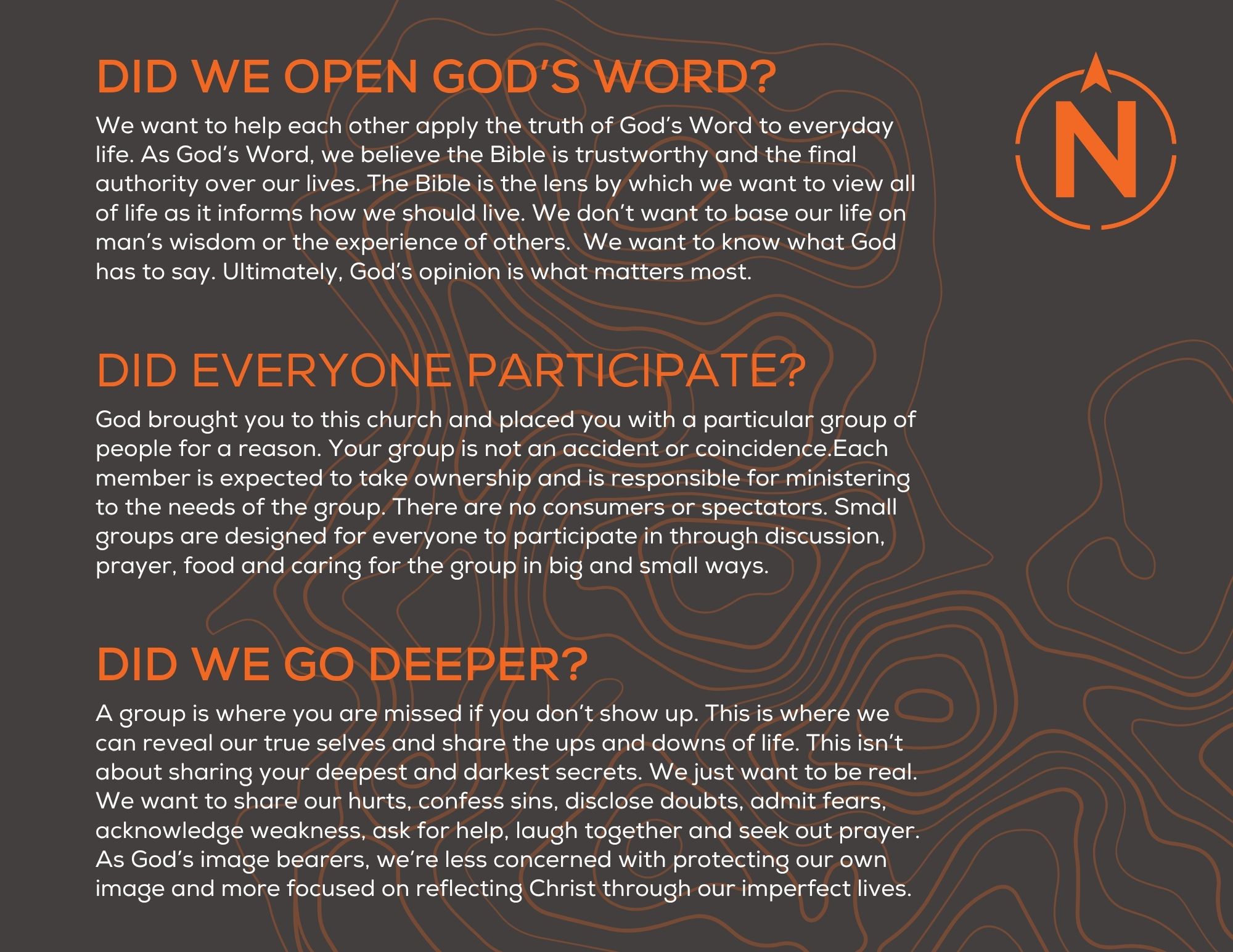
If you are a new leader or have been leading for a long time, you know that it can be difficult to monitor progress or know if you’re doing the right thing. At times, it’s easy to become discouraged and doubt if God is working in your small group or question if your group members are moving in the right direction. Here are three simple questions to measure your group.MONITOR PROGRESS

Go deeper. Go farther. Go beyond the surface.
Where and when do small groups meet?
Groups meet in various homes on Sunday, Monday, Tuesday, Wednesday, Thursday and Friday evenings. We also have some groups that meet at church. We currently have groups in Danville, Heritage Lake and Plainfield.
How often do groups meet?
Most groups meet two times a month from the middle of August through the middle of May. We take a break during the winter holidays and summer. The groups that meet at church (men, women, and care groups) typically meet every week and then take a break between various studies.
What is the commitment?
Joining a group requires an 8-10 week commitment each semester to attend the weekly gatherings and prepare ahead of time. Commitment is key to building group momentum and deep relationships. We understand that illness, work commitments and family trips come up; however, the depth of each group depends on the commitment of each member.
How important are groups at Northview?
Groups are the heartbeat of our church because we believe circles are better than rows. This is the place where a large church feels small and you are missed when you don't show up. Groups are also the place where ownership and discipleship can happen during the week as groups gather around God's Word, grow deeper together and then go back to their sphere of influence.
Is childcare provided?
It depends. Our groups are not designed as family groups where everyone interacts together. Groups are intended for adults. While some groups can offer childcare, parents are ultimately responsible for arranging childcare during their group. This can include hiring a babysitter, coordinating childcare with other families or swapping childcare with someone from another group who meets on a different night. We know this is a challenge for many families, but groups are trying to minimize distractions and create the right kind of environment for God to work in a powerful way.
How are groups selected?
We have lots of options. Some groups are self-selected based on your interest or availability. While there is no specific formula for assigning members into various groups, some factors include: group size, available openings, stage of life, location, requested person(s) and the dynamics of each small group. Ultimately, the best way to join a group is to ask to be a part of an existing group.
Do I have to be a member of Northview to join a group?
No. Membership is not required in order to join a group. However, if you are joining a group that is doing a sermon-based study, we do expect for you to attend the service or watch the service online so you can participate in your group discussion and get the most from your group.